Our Work in Bolivia
For over fifteen years, Healing the Children North East (HTCNE) of the United States and the Sirari Rotary Club of Santa Cruz de la Sierra, Bolivia, have organized an annual week-long surgical campaign during which children with cleft lip and palate receive corrective surgeries free of charge. The surgical program has been led by Dr. Steven Roser, DMD, MD, of Emory University, and Dr. Vincent Carrao, DDS, MD, of Mount Sinai, New York.
Once HTCNE team, which include maxilofacial surgeons, anesthesiologists, pediatricians, specialized nurses, speech language pathologists, technicians, students, and team coordinator return to the United States, the long-term follow-up of patients remains under the care of local professionals in Bolivia. Their progress is monitored by interdisciplinary teams that include local specialists in maxilofacial surgery, orthodontics, and pediatrics, working in coordination with the Sirari Rotary Club.
Four years ago, the Catholic University of Santa Cruz de la Sierra inaugurated its Department of Fonoaudiology, one of the few programs of its kind in the country. The program’s first cohort of students is expected to graduate within the next two years, marking an important milestone for the development of fonoaudiology in the region.
Three years ago, the Sirari Rotary Club and the Catholic University of Santa Cruz de la Sierra established a partnership to develop protocols for the follow-up care of children receiving cleft lip and palate surgery through the HTCNE program.
This follow-up process is essential for evaluating patient outcomes, identifying best practices in post-surgical care, and strengthening local capacity so that long-term treatment can increasingly be led and sustained by local professionals.
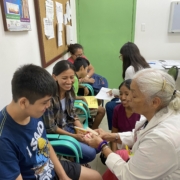
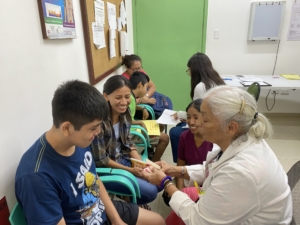
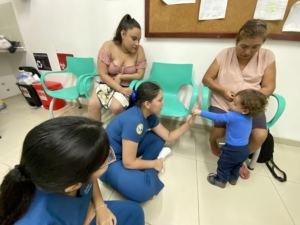
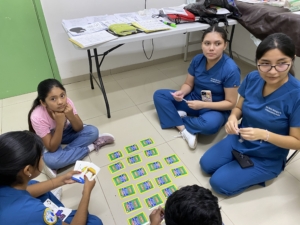
As part of this effort, professionals such as myself contribute to the training and mentorship of students in the program. During the 2026 surgical campaign, held from January 17 to January 24, I trained four students in the evaluation and treatment of hypernasality in post-surgical cleft palate patients.
The training included identifying parameters of hypernasality, applying therapeutic techniques to reduce hypernasal speech (when possible), and teaching strategies for proper speech production. Students were also trained to guide parents and caregivers so they can support the children in practicing speech exercises at home.
Such post-surgical care is essential, because while surgery is a critical step, proper follow-up therapy is needed for patients to fully realize the functional benefits of the intervention, and thus ensure successful outcomes in speech production, particularly for cleft palate patients.
The follow-up initiative in Bolivia includes plans to establish a permanent clinic in Santa Cruz de la Sierra where patients can receive post-surgical care. The facility is expected to be operational by 2028. In the meantime, a temporary consultation space is being negotiated, and will allow students to begin providing follow-up therapy under the supervision of university faculty.
By integrating structured follow-up care—including speech therapy and training for parents and caregivers—this program establishes a more comprehensive model of treatment. This initiative is intended to serve as a pilot program within the HTCNE network, with the goal of replicating this model in other countries where cleft lip and palate surgical campaigns are carried out.
This approach could become a standard practice not only for cleft care programs but for humanitarian medical initiatives more broadly, recognizing that meaningful care extends beyond the operating room.
Ultimately, the success of these children depends on a network of support. Their recovery and development require ongoing care, family involvement, and community engagement. As this program grows, it is my hope that sustained collaboration between surgical teams, local professionals, families, and educational institutions will create lasting change for patients and their communities.
Ysabella Hincapié-Gara
MSEd., MA CCC-SLP
Stories from Ukraine
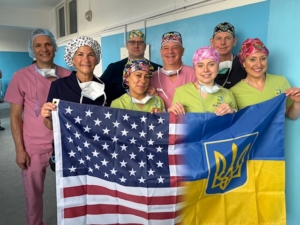
Ukraine. It was a nice reunion, as I haven’t seen many of them since last
May. This is my fifth trip to Ukraine, three of the five trips were working
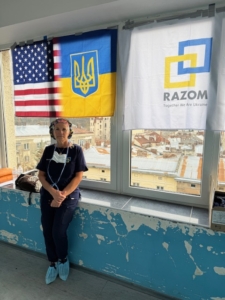
at this military hospital with HTCNE & Razom. Razom translates to “together”
and is an American-Ukrainian organization who hosts us during our time in
Ukraine. We are part of their “Co-Pilot” program, making it possible for
Ukrainian doctors to learn from the West.
patients and set up the operating rooms. Almost all the patients are male
soldiers, as well as two female civilians. For the past several months the
team has met on Zoom to virtually screen patients, deciding which surgeons
will do which case, but now in person final decisions are made. We store 6
large suitcases of supplies with our host Razom and we also brought 12 more
bags of supplies with us.
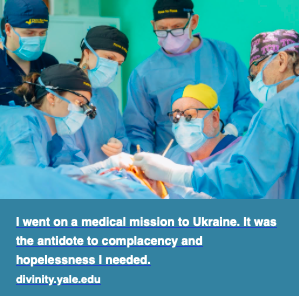
20 minute walk to our hotel. The surgeries are all head and neck, some were
for facial paralysis (nerve damage), severe eye injuries, facial
reconstruction. On this mission, there were 2 specialists that make custom
ocular prosthetics. From the patients CT scans, they make new “eyes” even
hand painting the exact eye color for the patient. Remarkable work. This
prosthesis is helping the patients re-enter society after their devastating
injuries. Some of the surgeries were nerve transfers, soft tissue (not bone)
transfers to build up lost facial tissue, taking fascia from the thigh to
fill in the side of the face that has a large defect, and ear reconstruction
to name a few. I tried to be sure to speak to every patient as they entered
the OR (with a translator). I introduce myself and reassure the patient
that our team will take very good care of them and it is our honor to take
care of them. They are all so thankful and appreciative that we came there
to help them. Some of the patients our team has cared for on previous
missions, so now it’s time to continue the reconstructive process, so for me
there are some familiar faces.
24th. The day started for us at 4am with the warning to seek shelter. I have
apps on my phone that will sound an alarm if there is a threat of drones,
missiles etc. There is a map that shows which regions are at risk. It is
very loud. The instructions are to go to the basement of the hotel where
there are no windows. We were there about an hour and a half. At 5:30am it
was time to get ready for work, eat breakfast and go to the hospital at 7am.
We started the day a bit more tired, but everyone continued to do their jobs
as usual. In the afternoon, while we were actively doing our cases, the
alarm sounded again. Sometime, around 4:30pm we were told that a drone hit a
building on St Andrew Church property in Lviv. I have visited this church on
other trips and 2 days earlier when we were walking home from the hospital.
There were 556 drones deployed across Ukraine that day and 541 were
successfully intercepted. Unfortunately, 15 drones did get through. Overall,
between March 23rd & March 24th, a total of 948 strike drones were launched.
team of nurses and techs were terrific. Six of us have been on this mission
before and I had 2 new Canadian nurses on this trip. Everyone worked so well
together and each one knew how to do their job well. Each day varied with
the finishing of cases and we left the hospital between 8:30-10pm. Leaving
the last day, there are always hugs, many thanks and small gifts to the
local staff that help us all week. They are so appreciative that we come to
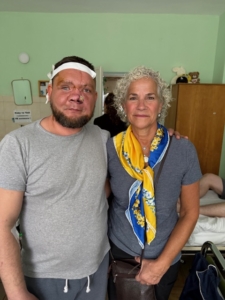
help their people. I joined the surgeons that were seeing the patients on
rounds. I usually never see a patient once they leave the operating room. It
is meaningful to me to see them awake, alert and many are actually smiling!
They are so very appreciative that our team came to care for them.
March 2026