Congratulations Missy Law, Director of HTCNE
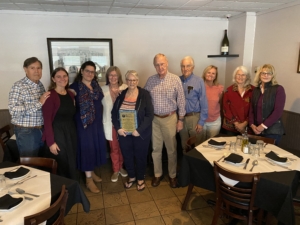
HTCNE Board Members and Staff celebrate Missy Law’s 40 years of service
September 15, 2025, marked Melissa “Missy” Law’s 40th work anniversary with Healing the Children Northeast. This milestone speaks volumes about her unwavering commitment to help those in need. Over the years, Missy has been a driving force behind the organization’s growth and impact, working tirelessly to streamline operations, reduce costs, and enhance efficiency. Her dedication ensures that HTCNE can reach and support as many children as possible.
Missy writes, “I came to volunteer at HTCNE in 1985 when my first son was born and I was a volunteer for the first nine years. When HTCNE brought children to the U.S. to receive medical treatment, several did not have a foster placement, and I opened my home and heart to those children who are now healthy adults. Throughout the years, I have worked in each program but the Medical Teams Abroad program has always been where my heart is. I feel honored to work with the greatest group of people- both medical team personnel, office staff, and foreign hosts. It is so rewarding to send these teams out and see the end-results in how many children we were able to help versus bringing in one child at a time. The gratification is to see how our team changed their life! This organization has changed my life and I feel privileged to have such a rewarding job!”
Congratulations Missy! Your passion and perseverance continue to inspire. Thank you for everything you do!
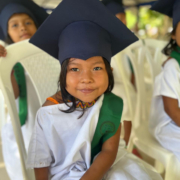
Medical Trip to Santa Marta, Colombia
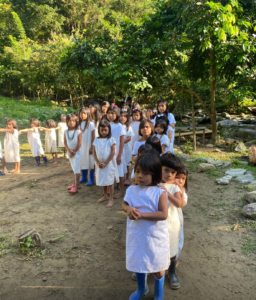
In October 2024, after the medical trip to Santa Marta, Colombia, 8 team members did a four-day trek to The Lost City. The Lost City or “Ciudad Perdida” is the archaeological site of an ancient city in the Sierra Nevada de Santa Marta, which is believed to have been founded about 800 AD. It was discovered in 1972 and is only accessible by trekking through the jungle. On day two of their hike, the guide showed the team members a school for local indigenous children, but it was a Sunday, and the school was not in session. On the way back to Santa Marta, the team stopped again at the school on a Tuesday when the children were there and met Natalia Feria, a teacher at the school. Dr. Eddie Castillo asked Natalia what would be the number one thing that the school needs and she said, “solar panels”. The school receives help from the government with the School Food Plan (PAE). Food gets shipped every 15 days and they supplement it with food they grow, such as plantain, yuca, malanga, and other tubers. The weather is hot and humid, and food perishes quickly without refrigeration, leaving nothing for the children to eat except rice and grains. Animal products and vegetables just don’t last. They have no electrical power, making conventional refrigerators and coolers useless. The only solution in this remote setting is the use of solar powered refrigerators and freezers. These refrigerators would allow them to store food for longer periods and feed the children breakfast and lunch. As Natalia said, “We want to properly feed these children and if possible, eliminate hunger.”
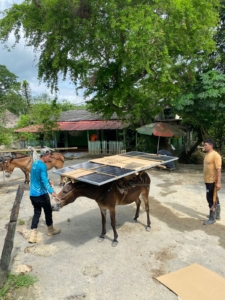
In 2025, Healing the Children Northeast raised $10,000 USD for The Lost City Elementary School Fund, which provided for solar panels for the school. With the help of UNIMA (our in-country hosts in Santa Marta, Colombia, where we send medical teams twice a year) they coordinated the logistics to get the equipment, tech support, delivery, and installation of the solar panels to the community, which was done by a team of donkeys. Healing the Children Northeast and the Santa Marta team are pleased to be able to fight hunger by providing solar electricity and refrigeration to this school for indigenous children.
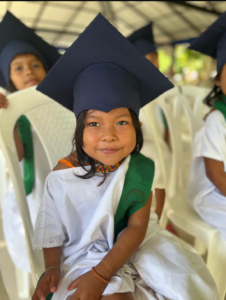
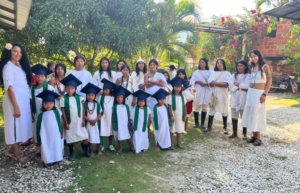
Natalia Feria, a teacher at the school, provided a write up on the need in this community: “The Lost City Elementary School ‘AMOR’ was built as a donation from a Swedish family. It found its origin from the vulnerabilities that exist in the indigenous communities that inhabit the path of The Lost City in the Sierra Nevada of Santa Marta, Colombia. Although these communities are entirely autonomous, when confronted with civilization they had the need to assert their rights before civilians and the state to protect their existence. It is for that main purpose as to why the school exists today. The native communities need to read, write and be represented in government to preserve their culture and autonomy. Of the native peoples, the most represented are the Arhuacos, Wiwa and Kogui cultures. Most kids at the school are Kogui’s, the remaining are Wiwa’s who live closer to the school. These communities are governed by the law of origin which is to go at the pace of nature, its processes, and cycles. In these communities, education consists of preserving their way of life by preserving their land, autonomy, and roots. This is taught at home by parents and elders. At the AMOR school, we have our own education model. The goal is to comply with all the legal requirements set by the Ministry of Education and at the same time imprinting a very valuable cultural seal. For example, in addition to cultural curriculum, we teach weaving, sawing, planting and mother tongue classes. We constantly seek the advice, support, and wisdom from the native elders in the community who visit the school. As for myself, an attorney from Bogota, when I first came to this community as a tourist in January of 2022, little did I know that I would be fulfilling my life mission here which is to help. God led me here to this marvelous place with so many beautiful children. My role as an educator is to help them preserve their culture and autonomy. History has seen many civilizations perish due to disease, malnutrition, and ignorance. That is why I could not leave. No one can think and create if they are hungry. Thanks to our persistence, today we have 65 students from different parts of the mountain. As we grow, our goal is to expand by opening a Kindergarten. We project a growth to over 80 children within the year.”